
Set Up Supplier / Service Provider List
|
Content |
|---|
In this process, you will be setting up the list of suppliers and service providers.
It is recommended to set up the default details e.g. payment methods, GL accounts and group them into class templates to speed up the set up of supplier profiles.
Connected Business includes default supplier class templates that you can modify or add to.
At the end of this session, users will set up the details for suppliers, group the details into class templates and create the list of suppliers.
Set Up Details for Suppliers
Set Up Default Details for Suppliers
To complete this task, do the following:
Set Up Payment Methods
Payment Methods classify suppliers by payment methods accepted Check Only, Check and Remittance, e‐Banking, Remittance Only.
- Go to the Supplier Module > Setup > Payment Methods to bring up the Payment Methods form.
- Enter the payment method name (e.g. Credit Card / Paypal and description).
- Select the payment type to assign (e.g. Remittance).
The options are:
- Remittance – process and print payments with bill, payment and applied credit details
- Cheque / Check Only – process and print checks.
- Cheque / Check and Remittance – process and print checks with remittance details.
- Remittance and File – process and store payment information through e-banking.
- Remittance – process and print payments with bill, payment and applied credit details
SET UP SUPPLIER FACTORS

This task is for those who deal with some suppliers through a third party payment institution called “factors”. When assigned to suppliers, printed checks and remittances will be addressed to the factor who will accept the payment for the supplier.
- Set up the information for new factors. Go to the Supplier Module > Setup > Factors to bring up the Factors form. Below is an example of how to create a supplier factor:
|
Factor |
|
|
General |
|
|
Factor Code |
[to be generated] |
|
Factor Name |
|
|
Country |
United Kingdom |
|
Address |
152 High Road |
|
City, State, Postal Code |
|
|
Telephone \ Ext |
|
|
Fax \ Ext |
|
|
Is Active? |
Yes / No |
|
|
|
|
Website |
|
|
Bank Details |
|
|
Bank Sort Code (for UK banks) |
|
|
Bank Account Number |
|
|
Bank Payment Reference |
|
|
Bank Account Name |
|
Create Supplier GL Class Templates
To complete this task, do the following:
- If tracking expenses by expense type, you will need to define Supplier GL Class Templates. Then, assign them to Supplier Class Templates. To track expenses by supplier/service provider type or location, you will need to do a few things first. Below is a representation of how to set up Supplier GL Class Templates that will track expenses by supplier/service provider type:

- Define account codes to assign to the GL Class Templates (e.g. Expense – Service Charges). Use the New Chart of Accounts Wizard (Accounting Module > Accounts > New Account Code) to add new account codes. You can create segments for the account codes you will create (e.g. Supplier/Service Provider Type or Location).
- Create the Customer GL Class Templates. Go to Supplier Module > Setup > GL Class Templates to bring up the Supplier GL Class form. Click on the New option to create new GL Class Templates. Below is an example of how to assign account codes to the Supplier GL Class.
Payables:
Sample Supplier GL Class: Service Provider GL Class Template
Control Account - Creditors / Account Payable
Expense – Settlement Discount Taken
Control Account – Over Invoiced Value
Control Account – Accrued Creditors / Accounts Payable
Purchase Header
Expense – Freight
Expense – Other
Purchase Item Lines:
Expense – Service / Non Stock
e.g. Service Charg
- Set the Supplier Preference to use the account codes assigned to supplier GL class templates (Supplier > Setup >Preferences > Preferences). Enable the option, Use GL Account Code for Service/Non-Stock. Click Ok to accept the changes.
Group Details to Supplier Class Templates
Supplier Class Templates group default values for new supplier information. Supplier Class Templates are selected when creating new suppliers/service providers to fill up most of the information for you.
Note that Connected Business includes default supplier class template for each country. You can modify the default class templates or create new depending on your needs.
- After creating the default details for suppliers e.g. payment methods, purchase tax you can now group the details by supplier class templates. Below is a representation of how supplier class templates are set up:
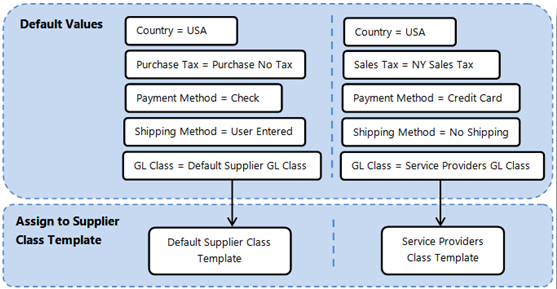
- Create the Supplier Class Templates. Go to the Supplier Module > Setup > Supplier Class Templates Below is an example of how supplier class templates are set up:
Supplier Class Template
General
Class Code
e.g. Service Providers Class Template
Description
e.g. Service Providers Class Template
Setup
Country
Currency
Payment Term Group
e.g. Net Terms
Payment Term
e.g. Net30
Tax
e.g. California State Purchase Tax
Shipping Method Group
e.g. Default
Shipping Method
e.g. No Shipping Required
Location
e.g. MAIN
Credit Limit
e.g. 15000
Source
Payment Method
e.g. Credit Card
Factor
Accounts
GL Class Template
e.g. Service Provider GL Class Template
Options
Is Active?
Yes

Set Up Supplier List
Import Supplier List
To complete this task, do the following:
This task is for those who want to import their list of suppliers/service providers. Importing is the easiest way to create your items especially if you have your existing suppliers list.
- If you are using any business or accounting software prior to Connected Business, you can collect the supplier list and have them either printed or exported into file – Excel, CSV, HTML or XML formats.
- You will need to format the list into a template used by Connected Business. You can import your list in Excel, CSV or HTML format.
- Create an import template of your item list or restructure your existing list into an import template used by Connected Business.
Fill up the “Suppliers.xls” template.
Download the import template files (XLS) and if you haven’t downloaded them.
Click here to download the file. - When ready to import, go to the System Manager Module > Import to bring up the Import Wizard.
- Use the Next buttons to move from each step to the next.
The column in the import files can be in any order however, the column names must not be replaced. If you will put in a lot of numbers in a column, format the column into “Text” to avoid losing the actual value.
Avoid using special symbols such as apostrophes or plus signs.
You do not need to fill up every column in the import file as the default Supplier Class Template will provide the details for it. You may need to check the default supplier class template and make changes when needed. - Click on the ellipsis button in the Source Path field or click on the Add Files button. Then, browse for the import file and select. Make sure that the file is not opened or in use.
- Select Customer as the Destination Table. This indicates the table in the database that the imported data will be placed.
- Click Next to go to the next page and click on the Import button to start importing. The wizard will warn you of the problems that may occur during the import. If the import failed, refer to the Import Log to know which columns or rows you may need to check. You can also save the import log for reference.
- If the import was a success, continue to the last step of the wizard and click Finish to exit.
- Check for the customers you have imported. Go to the Supplier Module > Supplier > Find Suppliers.
Create New Suppliers Using the New Supplier Wizard
To complete this task, do the following:
Create a New Supplier With the Same Billing and Shipping Information
This task is for those who want to set up their supplier list by setting up each supplier detail.
Go to Supplier Module > Supplier > New Supplier to bring up the New Supplier Wizard.
Create a new supplier
- From the first page of the New Supplier Wizard, select the option, Create New Supplier with the Same Billing and Shipping Information.
- Enter the supplier name and full name of its primary contact.
- Select the class template to use.
Provide billing and shipping information.
- In the Setup tab, you will find that most of the fields are already filled in by the class template.
- Add the supplier address and contact information.
- Change the default details filled in by the class template as necessary.
- Enter you account number with the supplier for reference.
Provide default contact information
- In the Default Contact tab, you will find that the information you entered in the previous page was copied onto this tab. Provide the Contact Name and modify the details as necessary.
Finish or Add New
- From the last page of the New Supplier Wizard, you can either finish the setup by clicking or create a new supplier by clicking on the Add New option.
Create a Supplier With a Different Billing and Shipping Information
Go to Supplier Module > Supplier > New Supplier to bring up the New Supplier Wizard.
Create a new supplier
- From the first page of the New Supplier Wizard, select the option, Create New Supplier with Different Billing and Shipping Information.
- Enter the customer name and full name of its primary contact.
- Select the class template to use. Click Next to continue.
Provide the billing information.
- In the Setup tab, you will find that most of the fields are already filled in by the class template. Add the customer billing address information and modify the values filled in by the class template.
- Change the default details filled in by the class templates as necessary.
Provide the default contact information.
- In the Default Contact tab, you will find that the information you entered in the previous page was copied onto this tab. Provide the Contact Name and modify the details as necessary.
Provide the shipping information.
- In the Setup tab, you will find most of the fields are already filled in by the ship to class template. You have the option to copy from an existing ship from location.
- Provide the customer shipping address and contact information.
- Change the default values filled in by ship to class template as necessary.
Provide the shipping default contact information.
- In the Default Contact tab, you will find the information you provided in the Setup tab was copied onto this tab. Provide the Contact Name and modify the details as necessary.
List the products available in the supplier “ship from” location.
- In the Default Contact tab, you will find the information you provided in the Setup tab was copied onto this tab. Provide the Contact Name and modify the details as necessary.
Note that you can skip this step and add list the supplier products and services later. Creating the supplier products and services list will be discussed in Set Up Supplier Products and Services List.
Finish or create new.
- From the last page of the New Supplier Wizard, you can either finish the setup by clicking Finish or create a new customer by clicking on the Add New option.
Create a New Supplier Ship From Location
Go to Supplier Module > Supplier > New Supplier to bring up the New Supplier Wizard.
Create new shipping information.
- From the first page of the New Supplier Wizard, select the option, Create a new supplier ship from information.
- Select the supplier from the list. Then enter the full name of the primary contact of the shipping address.
- The default country is selected. Enter the postal code of the ship to location. The country and postal code will filter the ship to class templates.
- Select the ship to class template to use. Click Next to continue.
Provide the setup information.
- In the Setup tab, you will find that most of the fields are already filled in by copying information from the supplier you selected.
- You can choose to change this information or copy from another supplier ship from.
- Add a ship to name and address information. Modify the information provided by the ship from you copied if necessary.
Provide the default contact information.
- In the Default Contact tab, you will find that the information you entered in the previous page was copied onto this tab. Provide the Contact Name and modify the details as necessary.
List the products available in the supplier “ship from” location.
- In the Default Contact tab, you will find the information you provided in the Setup tab was copied onto this tab. Provide the Contact Name and modify the details as necessary.
Note that you can skip this step and add list the supplier products and services later. Creating the supplier products and services list will be discussed in Set Up Supplier Products and Services List.
Finish or create new.
- From the last page of the New Supplier Wizard, you can either finish the setup by clicking Finish or create a new supplier ship from location by clicking on the Add New option.
Update the Supplier Outstanding Balances
To complete this task, do the following:
Update Supplier Outstanding Balances and AP Account
To complete this task, do the following:
- Have your previous Accounts Payable reports ready.
- Consider the following before creating opening supplier balances:
- Check if there were entries created against the AP and Opening Balance (Equity) or if these accounts were updated by importing balances. Creating supplier opening balances will update the AR and Opening Balance accounts.
- Check if there were entries created against the AP and Opening Balance (Equity) or if these accounts were updated by importing balances. Creating supplier opening balances will update the AR and Opening Balance accounts.
- Decide if you will update supplier opening balances manually or import them.
Update Supplier Opening Balances Manually
- Go to Customer Module > Setup > Opening Balances to bring up the Opening Balance form.
- Select the customers that you will enter opening balances for.
- Indicate the type of opening balance – if outstanding invoice or credit (any overpaid amount, chargebacks or received payment for returned items).
- Indicate the date of the opening balance. It is ideal to put the actual invoice date to track the aging properly.
- You can optionally add document references such as the Supplier Invoice number or Reference Order number.
- Indicate the opening balance amount.
You can enter opening balance amount for each invoice or enter the total amount of all outstanding invoices. However, when entering the total amount, the aging of the outstanding balances will not be tracked separately.
- Specify the payment term of the opening balance invoice.
Below is an example of how supplier opening balances are created:
Supplier Opening Balances
Supplier
Type
Opening Balance Date
Total
Payment Term
Currency
e.g. Sports Authority
e.g. Invoice
e.g. actual invoice date
e.g. $1300
e.g. NET30
USD
- Review the AP account balances. Print the customer opening balance report. Go to Supplier Module > Reports Center to bring up the Reports Center window. Click on the Reports folder from the tree list and click on the Supplier Opening Balance Report. The preview of the report will be displayed. Click on the Print button to print the report.
IMPORT SUPPLIER OPENING BALANCES
This task is for those who want to import their supplier opening balances.
- If importing your supplier opening balances, you will need to format the list into a template used by Connected Business. You can import your list in Excel, CSV or HTML format. Then, use the Import option in the System Manager Module.
- If you are using any business or accounting software prior to Connected Business, you can collect the latest accounts payable report and have them either printed or exported into file – Excel, CSV, HTML or XML formats.
- Create an import template of your supplier opening balances or restructure your existing opening balances list into an import template used by Connected Business. You will need to format the list into a template used by Connected Business. You can import your list in Excel, CSV or HTML format.
Fill up the “SupplierOpeningBalances.xls” template.
Download the import template files (XLS) and if you haven’t downloaded them.
Click here to download the file. - When ready to import, go to the System Manager Module > Import to bring up the Import Wizard.
- Use the Next buttons to move from each step to the next.
The column in the import files can be in any order however, the column names must not be replaced. If you will put in a lot of numbers in a column, format the column into “Text” to avoid losing the actual value.
The values for the opening balances will be imported in the supplier’s currency e.g. USD so there’s no need to indicate the currency symbol. Avoid using special symbols such as apostrophes or plus signs. - Click on the ellipsis button in the Source Path field or click on the Add Files button. Then, browse for the import file and select. Make sure that the file is not opened or in use.
- Select SupplierOpeningBalances as the Destination Table. This indicates the table in the database that the imported data will be placed.
- Click Next to go to the next page and click on the Import button to start importing. The wizard will warn you of the problems that may occur during the import. If the import failed, refer to the Import Log to know which columns or rows you may need to check. You can also save the import log for reference.
- If the import was a success, continue to the last step of the wizard and click Finish to exit.
- Review the AP account balances. Print the customer opening balance report. Go to Supplier Module > Reports Center to bring up the Reports Center window. Click on the Reports folder from the tree list and click on the Supplier Opening Balance Report. The preview of the report will be displayed. Click on the Print button to print the report.
Make Adjustments to the AP Account Balances
- Should you need to add or subtract an amount from an opening balance invoice or credit e.g. you entered the wrong value, you can do a manual adjustment to update the AP account balances. You can create and adjustment entry that will add or deduct an amount to the AP account. To do this, go to the Accounting Module > Journal > New Journal to bring up the Journal form.
Below is an example of how an amount is deducted from the AP account:
Journal Entry
Account Code
Debit
Credit
Description
Accounts Payable
$30
$0
To correct the AP account balances
Opening Balance
$0
$30
Configure Purchase Settings
Configure Settings for Purchase Order Processing
To complete this task, do the following:
- Go to the Supplier Module > Setup >Preferences > Preference to bring up the Preferences form. In the General section of the Preferences form, you will find several options:
General Supplier Preferences
Suppliers
Use suppliers across all warehouses
Yes = suppliers will be set to ship to any warehouse
No = suppliers will be set to ship to only the assigned warehouse
Use supplier tax code for line items
Yes = the supplier tax code will be applied to products and services
No = the item tax code will be applied to products and services
Filter items according to suppliers
Yes = only products by the supplier will be shown in the item dropdown
No = all products will be shown in the item dropdown
Use supplier GL Account for service / non-stock items
Yes = the expense account assigned to the supplier (e.g. Rent or Lease Expense) will be used when a non-stock item line is added to the purchase
No = the assigned expense account assigned to the item (e.g. Service Changes) will be used when a non-stock item line is added to the purchase